How to Store Batteries for Maximum Battery Life
The Short Answer: Proper battery storage keeps performance up and prevents the short circuits and damage that come from improper storage. Store batteries in a cool, dry place out of direct sunlight, keep them in their original packaging or in separate containers so the terminals cannot touch metal objects, and hold them near room temperature to protect battery life. For long-term storage, keep a lithium-ion battery or other rechargeable battery at a partial charge rather than full or empty, and check it periodically.
Batteries lose capacity in storage when they are kept too hot, too cold, or left to discharge, and a stored battery that is mishandled can short circuit. Knowing how to store batteries correctly protects both safety and the money tied up in spare packs, backup power banks, and solar battery storage.
The rules hold across most types of batteries, but the ones that reward careful storage the most are the rechargeable deep cycle and lithium batteries that run backup, solar, and mobile systems, since those carry the highest cost and the longest expected service life.
How to Store Batteries
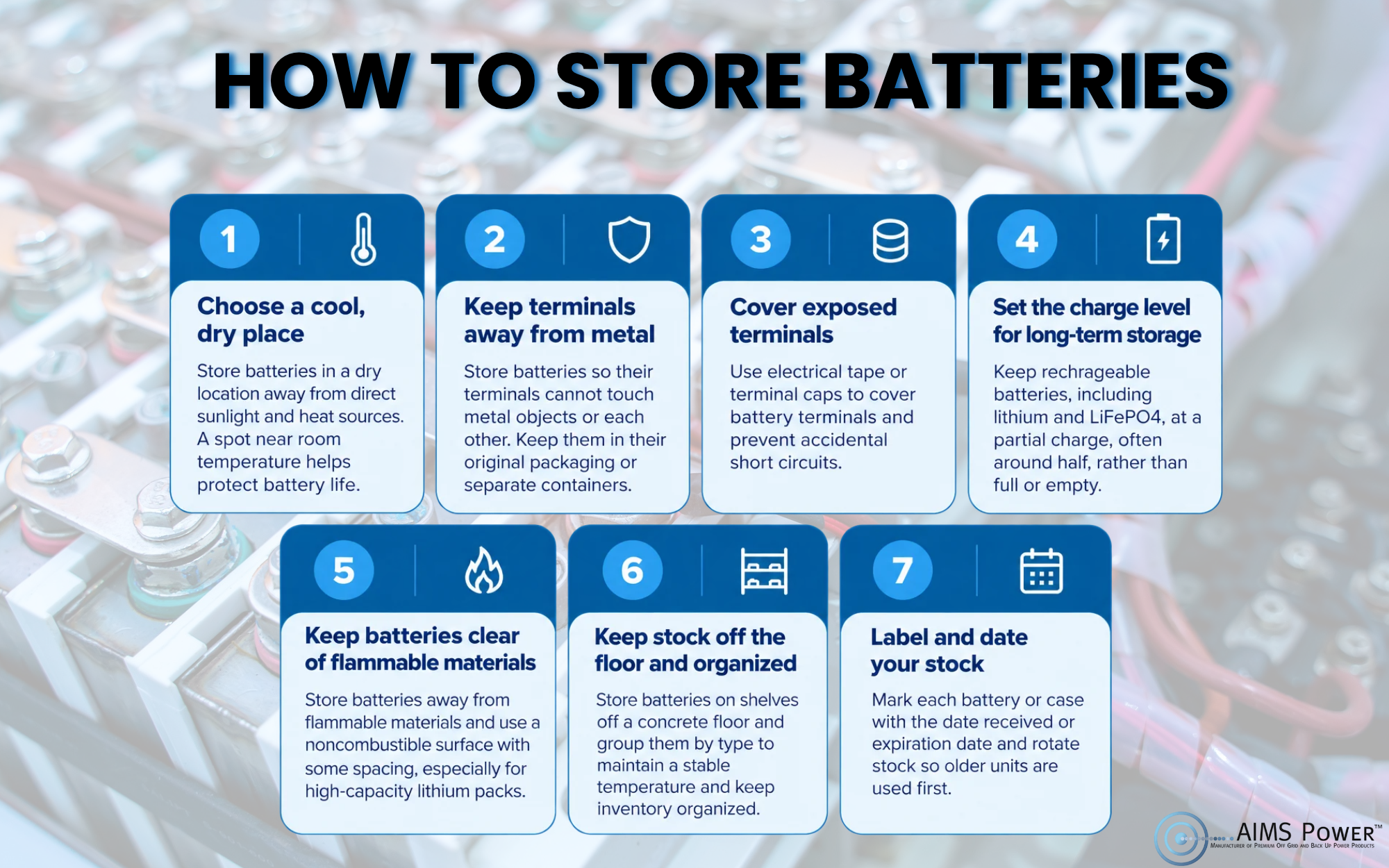
Proper battery storage comes down to a short list of steps that apply to most types of batteries:
- Choose a cool, dry place: Store batteries in a dry location away from direct sunlight and heat sources, since high temperature and high humidity speed up the chemical reaction that wears a battery down. A spot that stays near room temperature protects battery life better than a garage or shed that bakes in summer and freezes in winter.
- Keep terminals away from metal: Store loose batteries so their terminals cannot touch metal objects or each other, which prevents a short circuit that can heat a cell or start a fire. Leave a new battery in its original packaging until it is used, and keep spare batteries grouped in separate containers rather than loose with tools or hardware.
- Cover exposed terminals: On larger batteries or a battery pack, cover the battery terminals with electrical tape or terminal caps so nothing bridges the positive and negative terminals. This matters most for high-capacity packs, where an accidental short carries far more energy than a small cell.
- Set the charge level for long-term storage: Keep a lithium-ion battery or other rechargeable battery at a partial charge, often around half, rather than full or empty, since a cell held full is stressed and one left to sit can slip into a deep discharge and cause irreversible damage. Alkaline batteries typically store fine as they are.
- Keep batteries clear of flammable materials: Pick a storage area away from flammable materials, and give high capacity lithium packs a noncombustible surface with some spacing rather than a tight pile. Follow any local regulations for how batteries are stored on-site, since larger quantities can trigger fire-code requirements.
- Keep stock off the floor and organized: On a facility or warehouse shelf, store batteries off a concrete floor and grouped by type on labeled shelving, which holds battery temperature steady and keeps spare batteries from turning into a loose pile.
- Label and date your stock: Mark each battery or case with the date received or the expiration date and rotate stock so older units get used first, which keeps a new battery from sitting behind old stock long enough to lose capacity before it is installed.
Prepare Batteries Before Storing
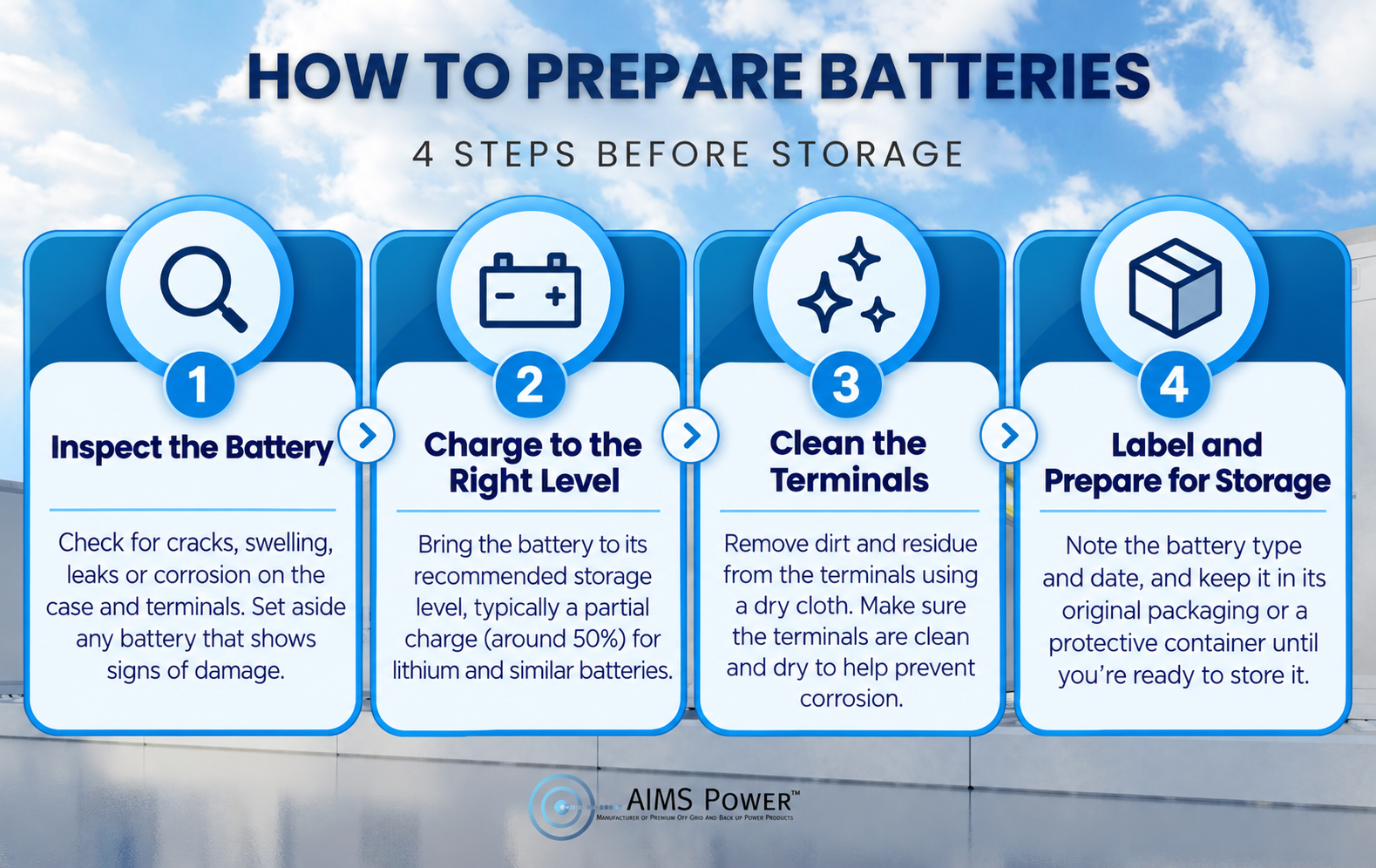
A few minutes of prep before a battery goes on the shelf prevents most storage problems:
- Inspect first: Check each battery for swelling, cracks, leaks, or corrosion on the battery terminals, and set aside any that show damage rather than storing a failing unit next to good stock.
- Set the charge: Bring a rechargeable battery to its storage level, a partial charge, before it goes away, since it is easier to set the level now than to catch a slow decline later.
- Clean the terminals: Wipe the battery terminals clean and dry, because residue and moisture invite corrosion during long term storage.
- Group by type and date: Keep each battery type together and label the batch, so lithium, AGM, and alkaline stock do not get mixed and older units are easy to pull first.
Storing Different Battery Types
Storage requirements shift by chemistry, so it helps to match the approach to the battery type. The two that matter most for backup and solar systems are lithium and AGM deep cycle.
Lithium-ion and LiFePO4 Batteries
A li-ion battery stores best at a partial charge, often around half, in a cool, dry spot, and it should not sit in extreme temperature or at a full discharge for long. These lithium ion cells power most lithium battery packs, power tool batteries, electric vehicles, and lithium backup and solar banks, and they carry a built-in management circuit that still draws a small amount while idle, so they need a charge check during long term storage. AIMS lithium iron phosphate models are a common lithium battery choice for backup and solar systems because they tolerate storage and cycling well.
AGM and Lead Deep Cycle Batteries
An AGM deep cycle battery is a common choice for backup and off-grid systems, and it holds a charge better than many battery types but still loses it slowly, so it needs a top-off charge every few months to avoid a deep discharge that sulfates the plates and causes irreversible damage. Store it fully charged rather than partial, which is the opposite of lithium, and keep it in a dry location at a steady battery temperature.
Maintaining Batteries in Storage
A battery in storage is not truly idle, since every rechargeable battery self-discharges over time and its battery temperature sets how fast. Check the charge every couple of months and bring it back to its storage level before it drops too low, because a deep discharge can cause irreversible damage that no recharge reverses.
A lead or AGM battery can sit on a quality maintainer that floats it at full charge, while a lithium battery should be topped up in stages rather than held on a constant float, since its chemistry does not need a trickle once full.
Keep the storage area near room temperature and out of high humidity, and for inventory held at a facility, a simple log of each battery’s storage date and last charge check makes rotation and warranty tracking far easier than guessing later.
What Affects Battery Service Life
Battery life is set as much by how a battery is stored and used as by the battery itself.
Temperature
Heat is the single biggest factor, since high temperature accelerates the chemical reaction inside the cell and shortens service life, while extreme cold can cut battery performance until the battery warms back up.
Discharge Depth
Depth of discharge matters too, because repeated deep discharge wears a rechargeable battery faster than shallow cycles, so a deep cycle battery kept in a moderate range lasts more cycles than one run flat each time.
Age
Batteries also age on the calendar, losing a little capacity each year even unused, and that aging speeds up when a cell is stored hot or at a full charge. For a backup or solar system that may sit ready for months at a time, storing the batteries correctly, near room temperature and off a full deep discharge, is what protects both battery performance and the years of service you paid for.
Storing and Replacing Batteries With AIMS Power
AIMS Power has spent more than 25 years, since 2001, building batteries for backup power, solar, and mobile systems. The lineup includes deep cycle batteries in AGM and lithium iron phosphate, built for the repeated cycling a backup or off-grid system puts them through. If you are stocking spare batteries, planning storage for a fleet or facility, or replacing packs that have reached the end of their service life, contact AIMS Power to match the right battery to your system.
Frequently Asked Questions
How do I store batteries so they last? +
Storing batteries so they last means keeping them in a cool, dry place out of direct sunlight, near room temperature, and away from metal objects that could short the terminals. For a lithium-ion battery or other rechargeable battery in long-term storage, hold it at a partial charge and check it every couple of months. These steps protect battery life and prevent the damage that comes from improper storage.
What temperature should batteries be stored at? +
Batteries should be stored near room temperature, out of extreme heat and extreme cold. High temperature speeds up the chemical reaction that wears a battery down, and extreme cold reduces battery performance until the battery warms up. The U.S. Fire Administration advises keeping lithium-ion batteries at room temperature and not charging them below freezing temperatures or in high heat.
Can I store loose batteries together? +
Storing loose batteries together is fine only if their terminals cannot touch each other or other metal objects, which would cause a short circuit. Keep a new battery in its original packaging, use separate containers for spares, or cover the battery terminals with electrical tape. This matters most for deep cycle batteries, or other larger batteries where a short circuit is a safety risk.
Should I store a lithium battery full or empty? +
A lithium battery should be stored at a partial charge, not full and not empty. A full charge held for a long time stresses the cell, and sitting empty can slip into a deep discharge that causes irreversible damage. A partial charge in a cool, dry place is the safest state for long-term storage.
How often should I check batteries in storage? +
Batteries in storage should be checked every couple of months, especially a rechargeable battery or an AGM deep cycle battery that self-discharges over time. Bring the charge back to its storage level before it drops too low, and look for swelling, leaks, or corrosion on the terminals. Alkaline batteries need less attention beyond a glance at the expiration date.