The Best Battery for Commercial Solar Storage
The Short Answer: The best battery for commercial solar storage is a lithium iron phosphate (LiFePO4) battery, which gives the long cycle life, deep usable capacity, and safe operation a commercial system needs, with a built-in battery management system to protect it. For most commercial and industrial sites, a 48 volt LiFePO4 bank sized to the load is the right build, since units can be banked together to reach commercial capacity. The right battery pairs clean, reliable storage with the demand-charge savings that make commercial battery storage pay off.
Commercial solar storage turns the power from a site’s solar panels into usable energy around the clock, holding it for the evening, for a grid outage, or for the peak hours when electricity costs the most, so a facility draws more from renewable energy and less from the grid and fossil fuels.
The battery decides how well the system does that, and for a commercial or industrial facility the right battery has to cycle daily for years, discharge deeply without damage, and scale to the load. The best choice comes down to the chemistry, the management system, and how the pack scales, and for most C&I sites that points to lithium iron phosphate batteries paired with the right capacity.
How Commercial Solar Storage Works
A commercial battery storage system sits between the solar array, the building, and the grid. During the day, the solar panels often make more power than the site uses, and the extra energy charges the battery instead of being sent back to the grid for little credit. When the sun drops or demand climbs, the battery discharges through an inverter to supply AC power to the building, and the system pulls from the grid only when it has to.
This behind-the-meter setup gives a facility control over when it uses stored solar energy rather than buying it at the utility’s peak rate. The battery, the solar PV array, and the inverter have to work as one battery system, so capacity, voltage, and charge rate all have to match for seamless integration and steady output.
What Makes a Battery Right for Commercial Solar Storage
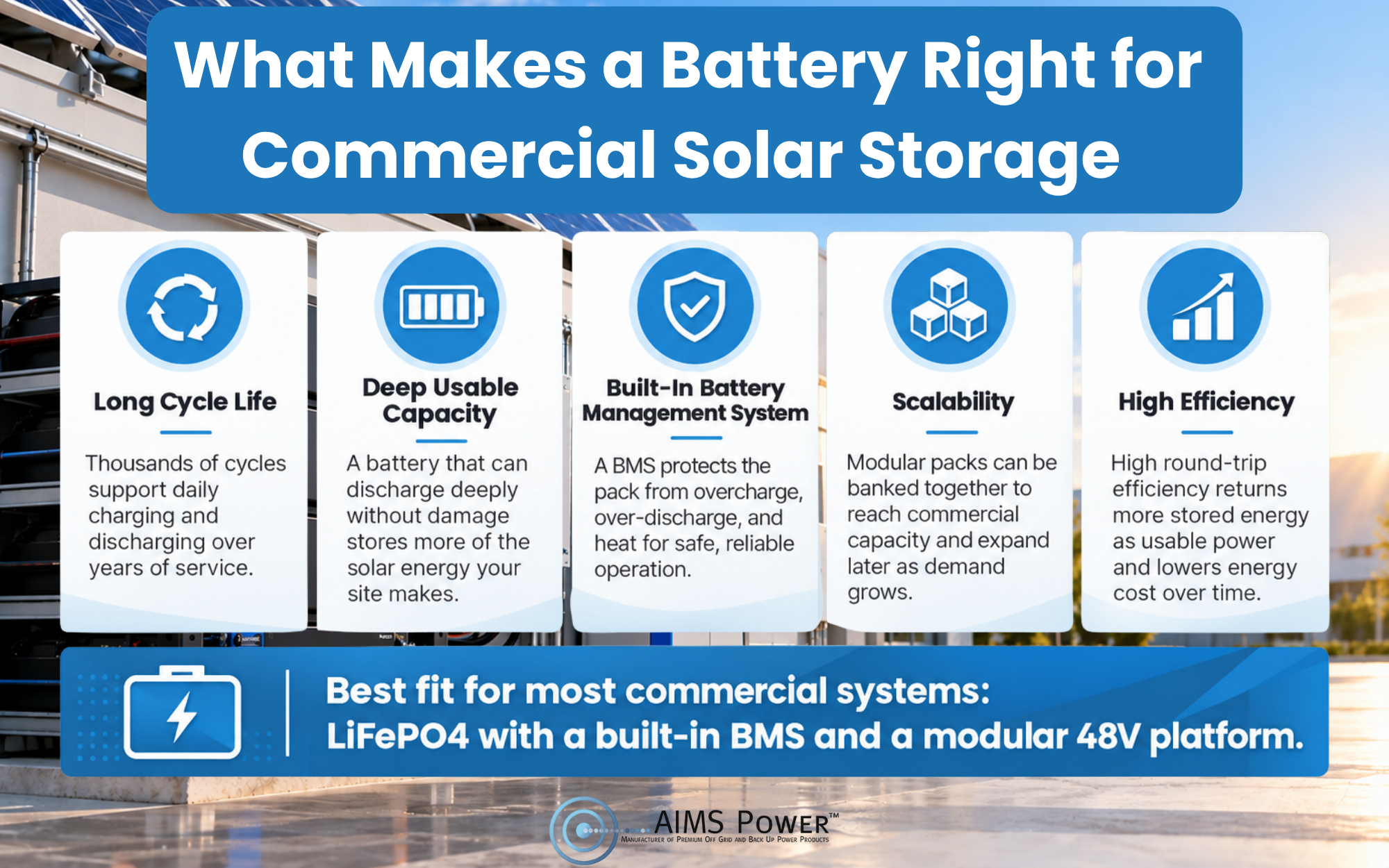
A commercial battery storage system runs harder than one for residential customers. It cycles every day, often discharges deeply, and has to hold up for years to earn back its cost, so the battery has to be built for that duty. A few things separate a battery that suits commercial systems from one that does not:
- Cycle life: A commercial system charges and discharges daily, so the battery needs thousands of cycles of service life, not hundreds.
- Depth of discharge: The usable capacity matters as much as the rated capacity, and a battery that discharges deeply without damage makes more use of what the solar panels produce.
- A battery management system: A built-in battery management system protects the pack from overcharge, over-discharge, and heat, which keeps a large battery energy storage system safe and reliable.
- Scalability: A modular design lets a facility add battery packs to reach the capacity it needs and expand later without replacing the whole system.
- Efficiency: A high round-trip efficiency means more of the stored solar energy comes back out as usable power, which keeps the energy cost down over the life of the system.
Why Lithium Iron Phosphate Leads for Commercial Systems
Lithium iron phosphate, or LiFePO4, is the chemistry most commercial battery storage is built on, and the reasons are straightforward. It delivers far more cycles than lead-acid and most other lithium-ion batteries, which matters when a system cycles every day, so the same bank lasts years longer before it needs replacing. It discharges deeply without the damage that shortens a lead battery, so more of the stored solar energy is usable and the system can be sized smaller for the same output.
It also runs cooler and more stably than other lithium chemistries, which makes it the safer choice for a large battery pack near a building or in an energy storage room, and it holds its capacity well across a wide temperature range.
Paired with a battery management system that guards against overcharge, over-discharge, and heat, a LiFePO4 bank gives the long, dependable service life a commercial system needs to pay off, which is why it has become the standard for commercial energy storage across the United States.
The Best AIMS Battery for Commercial Solar Storage
For a commercial solar storage build, the AIMS 48V 200Ah LiFePO4 Industrial Grade battery is a strong starting point. It stores about 10 kWh in a single industrial-grade battery pack, runs on a 48 volt platform that moves commercial power at lower current, and carries a battery management system built in.
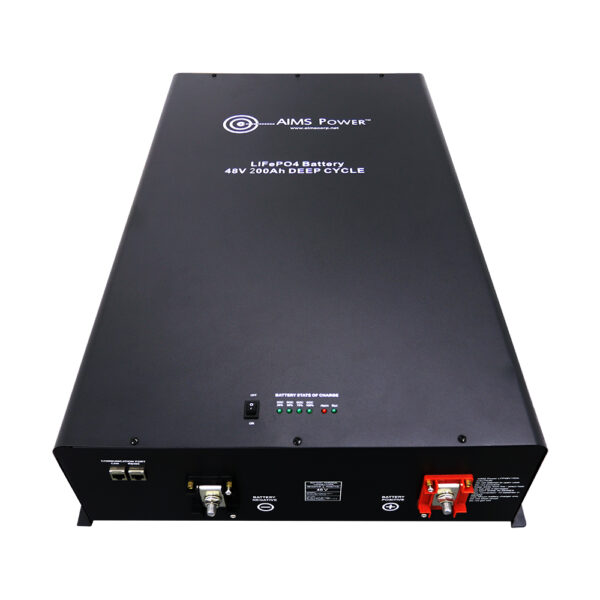
48V 200Ah Industrial-Grade LiFePO4 Battery
A strong starting point for commercial solar storage. This deep-cycle LiFePO4 battery combines reliable energy storage, built-in battery management, and the ability to bank compatible units together as your facility's needs grow.
Shop This BatteryBecause it is designed for high-power systems, units can be banked together to reach the capacity a commercial or industrial facility needs, so the same battery serves a small system or a large bank. For sites still scoping chemistry and capacity, the full lithium battery lineup covers the range a commercial system draws from, with a modular design and seamless integration with the solar PV array and inverter.
What Commercial Battery Storage Delivers
Energy Costs
The reason commercial and industrial customers add battery storage is the savings and reliability it brings, not the battery itself. Unlike residential customers, C&I customers face energy demand charges, and the largest driver of a commercial system is demand charge reduction.
Utilities bill commercial facilities for their highest peak of power draw, and a battery that discharges during those peaks shaves them down, a practice called peak shaving. Peak demand charges are a significant factor in whether a commercial battery energy storage system pass off, since the demand-charge savings are what fund the system. Beyond demand charges, storage lets a site hold cheap energy from off-peak hours and use it when rates are high, which trims the energy cost on every kilowatt-hour shift.
Backup Power During Outages
It provides backup power and a steady power supply when the grid drops, which protects operations at a site that cannot afford downtime. Where utility programs allow, a battery can support grid services and grid reliability, turning stored capacity into another source of value.
For commercial buildings, data centers, and industrial facilities, that combination lowers operational costs and electricity costs while adding resilience and shifting more of the load to clean, renewable energy sources.
Where Commercial Battery Storage Fits Best