What Does Ah Mean on a Battery? Amp Hours Explained
The Short Answer: Ah stands for amp hour, and it is the measure of a battery’s capacity, or how much charge it can deliver over a time period. A 100Ah battery can supply 100 amps for one hour, 50 amps for two hours, or 5 amps for 20 hours. The higher the Ah rating, the more energy the battery holds and the longer it can run a given load before it needs a recharge.
Anyone speccing a battery for a solar system, a fleet vehicle, or a backup power build runs into the Ah rating almost immediately, and it is one of the most misread numbers on a spec sheet. A higher Ah battery is not always the right battery, and two batteries with the same Ah rating can deliver very different real-world runtime depending on chemistry, discharge rate, and temperature.
This guide explains what amp hour actually measures, how it connects to watt hours and runtime, and what to check beyond the number on the label so you size the right battery for the job.
What Ah Actually Measures
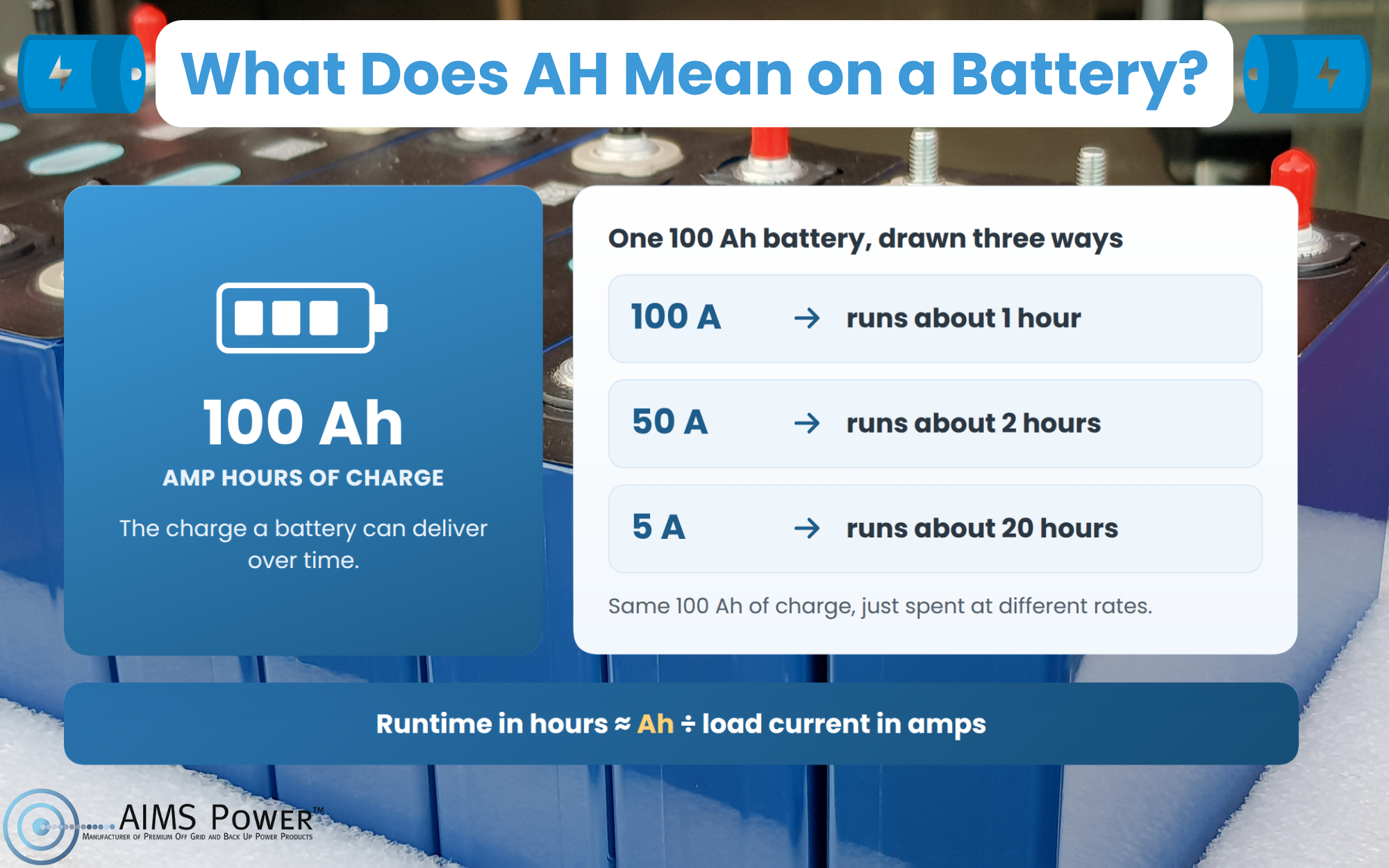
An amp hour, written as Ah, describes how much electric charge a battery can move over one hour. One amp hour equals a current of one ampere flowing for one hour. So a battery’s Ah rating tells you how much current it can supply and for how long, which is the practical definition of battery capacity.
Calculating Capacity
The relationship is straightforward. Divide the Ah capacity by the current your load draws, and you get the approximate system runtime in hours. A 200Ah battery running a 10 amp load lasts around 20 hours. Cut the load to 5 amps and the same battery runs for roughly 40 hours. This is why the Ah rating matters so much for sizing: it is the starting point for matching a battery to how long equipment needs to stay powered.
Important Context: The ampere hour figure describes charge, not total energy. Two batteries can share the same Ah rating but hold different amounts of energy if their voltage differs, which is where watt hours come in. Always check both numbers before attempting to combine batteries.
Ah vs. Watt Hours: Capacity vs. Energy
Amp hours measure charge. Watt hours measure energy. To compare batteries fairly, especially across different voltages, watt hours is the more exact number.
The formula is simple. Multiply the Ah capacity by the battery voltage to get watt hours. A 100Ah battery at 12V holds 1,200 watt hours. A 100Ah battery at a higher voltage, say 24V, holds 2,400 watt hours, twice the energy from the same Ah rating. This is why a spec sheet’s Ah figure alone can mislead. A 12V battery and a 24V battery both rated at 100Ah do not store the same energy.
When you calculate a load in watts, converting battery capacity to watt hours lets you match supply to demand directly, without getting tripped up by voltage differences between battery options.
Battery | Ah rating | Voltage | Watt hours |
Small 12V pack | 50Ah | 12V | 600 Wh |
Standard 12V | 100Ah | 12V | 1,200 Wh |
High-capacity 24V | 100Ah | 24V | 2,400 Wh |
Large 48V bank | 200Ah | 48V | 9,600 Wh |
Why Two Batteries With the Same Ah Rating Perform Differently
The Ah rating printed on a battery is measured under ideal conditions, usually a slow, steady discharge at a set temperature. Real applications rarely match the lab. Several factors change how much of that rated capacity you actually get.
Discharge Rate and Peukert’s Law
The faster you pull current from a battery, the less total capacity it delivers. This effect, described by Peukert’s law, hits lead-acid batteries hard. Draw a lead-acid battery down quickly and its usable Ah capacity can drop well below the rating.
A lithium battery holds up far better under a high discharge rate, delivering close to its full rated capacity even when the load is heavy. This is one reason a higher Ah lead-acid battery does not always outperform a smaller lithium one under real load.
Battery Chemistry and Usable Capacity
Chemistry decides how much of the rated capacity you can safely use. A lead-acid battery should only be discharged to about 50 percent before it shortens its life, so a 100Ah lead-acid battery gives you around 50Ah of usable capacity.
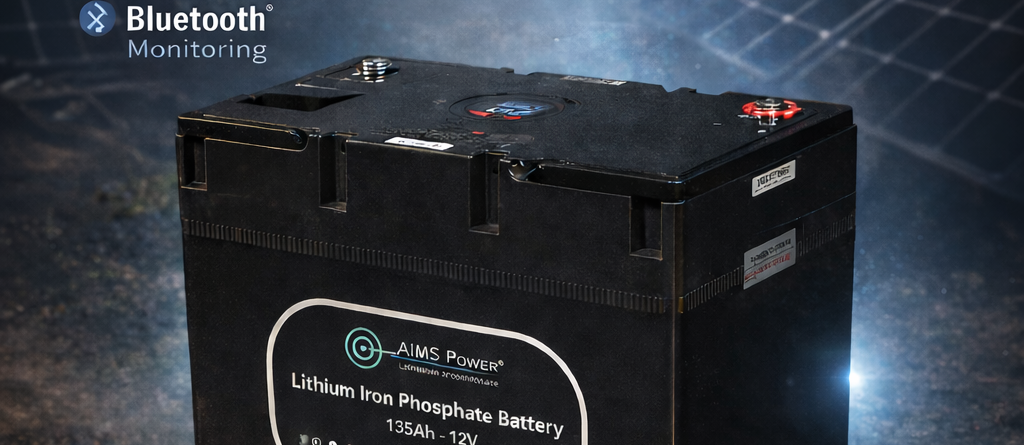
A lithium-ion battery, specifically LiFePO4, can be discharged to 80 to 100 percent, so a 100Ah lithium battery delivers 80 to 100 usable Ah. That difference means a smaller lithium battery often replaces a larger lead-acid one with the same real-world runtime.
Temperature
Batteries lose capacity in the cold. In cold weather and extreme temperatures, a battery delivers less than its rated Ah. Lead-acid chemistry is especially sensitive. Cold cranking amps, a separate rating you see on a car battery, measure starting performance in cold conditions, which is a different job than the deep, sustained discharge an Ah rating describes. For off-grid systems and fleet vehicles working through winter, temperature derating is important in the sizing math.
Internal Resistance and Age
Every battery has internal resistance that turns some energy into heat instead of usable output, and that resistance rises as the battery ages. A battery near the end of its battery life delivers noticeably less than its rated Ah capacity, which is worth planning for in any system meant to run for years.
How to Use the Ah Rating When Sizing a Battery
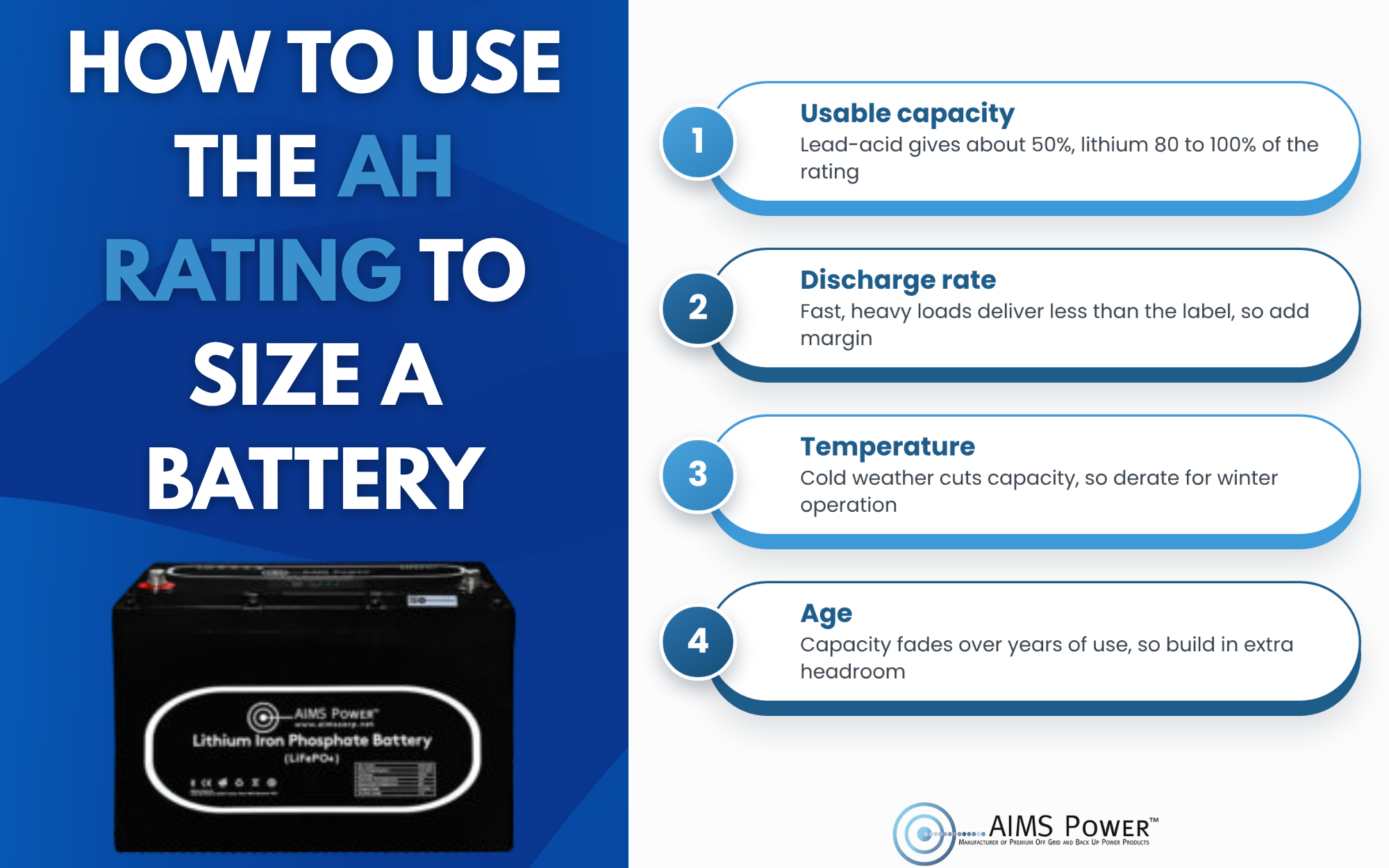
For a business speccing power, the Ah rating is where sizing starts, not where it ends. Start with the load. Add up the current your equipment draws, or convert your total watts to amp hours using the system voltage. Then decide how long you need to run between charges, which sets your target Ah capacity. From there, consider for the real-world factors that pull actual capacity below the label rating:
- Usable capacity: Apply the depth-of-discharge rule for your chemistry, roughly 50 percent for lead-acid and 80 to 100 percent for lithium.
- Discharge rate: Add margin if the load is heavy, since pulling current fast reduces the capacity a battery actually delivers.
- Temperature: Derate for cold weather when the battery works in low temperatures.
- Age: Build in headroom so the system still performs years into its battery life.
The C rating ties into this. A battery’s C rating describes how fast it can safely charge or discharge relative to its capacity. A 100Ah battery at 1C can deliver 100 amps, while the same battery at 0.5C is rated for 50 amps of continuous power. Matching the C rating to your load protects both runtime and battery life.
Where the Ah Rating Matters Most
The amp hour rating drives decisions across the applications AIMS Power builds for.
Solar and Off-Grid Systems
The battery bank’s total Ah capacity determines how long a solar setup runs overnight or through cloudy stretches. Undersize it and the system falls short after dark, so the Ah rating is the number that sets how much stored energy the array has to refill each day.
Fleet and Commercial Vehicles
An auxiliary or deep cycle battery sized by Ah keeps tools, refrigeration, and equipment running without draining the starting battery. Matching the Ah capacity to a full workday of loads is what lets a crew run gear between charges instead of idling the engine.
Backup Power
Ah capacity sets how long the system carries critical loads during an outage. The bigger the Ah rating relative to the load, the longer the equipment stays online before the batteries need to recharge from the grid, a generator, or solar.
Portable Power Stations and EVs
In a portable power station or an electric vehicle, higher Ah capacity means longer runtime or range, balanced against the added weight and size that capacity brings. Here the sizing tradeoff is capacity against portability.
In every case, the right battery is the one whose usable capacity, not just its label rating, matches the load and runtime the application demands.
Choosing the Right Battery With AIMS Power
AIMS Power is a U.S.-based manufacturer with more than 25 years building power conversion and energy storage products, backed by in-house technical support. Beyond batteries, AIMS builds the inverters, chargers, and solar equipment that make up a complete power system, so the components are designed to work together.
For installers, fleets, OEMs, and businesses sizing power for a build, that means one source for the equipment and the application help to match it to the load. If you are speccing a battery or an energy storage system, or sourcing at volume, contact AIMS Power to find the right fit for your application, or to talk through OEM and reseller options.