MPPT Charge Controller Selection for System Designers
The Short Answer: An MPPT charge controller sits between the solar array and the battery bank and converts the array’s higher voltage down to the voltage the battery needs, capturing the extra as usable current instead of wasting it. Maximum power point tracking lets it pull the most available power from the panels as sunlight and temperature change, which is why an MPPT controller delivers more charge than a PWM one, often 20 to 30 percent more in the right conditions. For a system designer, picking the right one comes down to matching the controller’s voltage range and amp rating to the array and battery bank.
For anyone designing a solar system, the charge controller is a small line item that decides how much of the array’s energy actually reaches the battery. Choose the wrong type or size and a well-built array underperforms, or worse, the controller sits outside its safe input range and fails. This guide covers how an MPPT charge controller works, how it differs from PWM, and the specific numbers to check when you spec one, so the controller matches the array, the battery bank, and the conditions the system runs in.
How an MPPT Charge Controller Works
A solar panel does not put out a fixed voltage. Its output changes with sunlight, temperature, and load, and there is one point on that curve, the maximum power point, where voltage and current combine to give the most power. An MPPT controller runs maximum power point tracking to sit on that point continuously as conditions change, so the array delivers the most energy it can at any moment.
Voltage
An MPPT controller also outperforms simpler controllers in how it handles voltage. It works as a DC converter, taking the array’s higher voltage and stepping it down to the battery voltage while converting the surplus into extra charging current. A panel running at a higher voltage than the battery does not lose that difference. The controller turns it into amps. This is why an MPPT solar charge controller can push noticeably more power into the battery than the panel’s nominal rating would suggest through a basic controller.
Solar Tracking
Because the tracking is automatic, the controller adjusts to full sun, clouds, and shifting light intensity on its own. The designer’s job is not to manage that behavior, it is to simply size the controller so it can handle the array’s range safely.
MPPT vs. PWM
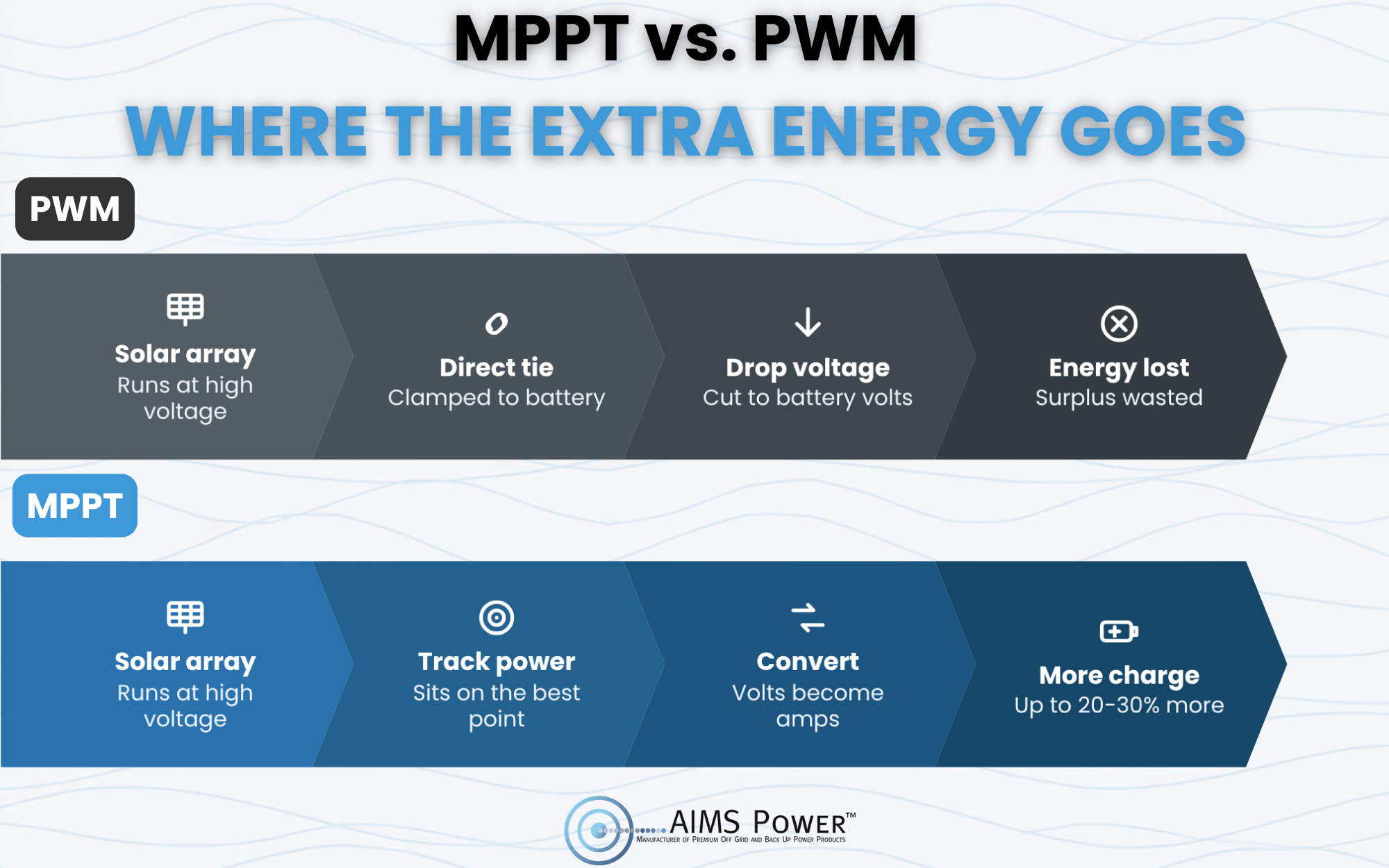
There are two main kinds of solar charge controllers, and the gap between them is in what happens to excess harvested energy.
How PWM Works
A PWM controller connects the array almost directly to the battery and pulls the panel voltage down to the battery voltage. Any voltage above the battery is lost. PWM charge controllers are inexpensive and fine for small systems where the panel voltage and battery voltage are closely matched, but they leave energy on the table whenever the panel runs at a higher voltage than the battery.
How MPPT Works
An MPPT controller converts that extra voltage into current instead of discarding it. The efficiency difference is largest when panel voltage sits well above battery voltage, for example a high-voltage array charging a 12V battery bank, or in cold weather when panel voltage climbs. AIMS MPPT controllers run at 97.5 to 99 percent conversion efficiency, which is where the added charge comes from.
Controller Type | How it handles voltage | Best for |
PWM | Ties array to battery, drops voltage to match | Small systems, panel and battery voltage closely matched |
MPPT | Converts extra voltage into charging current | Larger arrays, high-voltage panels, cold climates, maximum harvest |
For a system designer chasing the most energy from a given array, MPPT is the default. PWM stays in the toolkit for the smaller, cost-sensitive builds.
Sizing an MPPT Charge Controller
Speccing an MPPT controller comes down to two main numbers, the input voltage it can accept from the array and the output current it delivers to the battery. Get both right and the controller runs safely at full output. Get either wrong and you risk damaging the controller or wasting array capacity.
Check the Array’s Open Circuit Voltage
The most important safety number is the array’s open circuit voltage, the voltage the panels produce with no load. This peaks in cold weather, when panel voltage runs highest, and it has to stay below the controller’s maximum PV input voltage rating with margin to spare. A controller pushed past its input voltage ceiling on a cold, sunny morning can fail. Always calculate open circuit voltage at the coldest expected temperature, not at room temperature.
Match the Amp Rating to the Array and Battery
The controller’s amp rating sets how much charging current it can deliver to the battery bank. Divide the array’s total watts by the battery voltage to estimate the current the controller needs to handle, then choose a controller rated at or above that figure. Also check the controller manufacturer’s maximum PV wattage rating, as some systems allow limited overpaneling to maximize production during lower-light conditions.
Confirm Battery Voltage and Chemistry Support
The controller has to support the system’s battery voltage, whether that is 12V, 24V, 48V, or a controller that auto-detects across several. It also needs charge settings that match the battery chemistry. A controller with a lithium battery profile and multi-stage charging protects the bank and gets it to a full charge correctly, which matters as more designers move to lithium away from AGM and lead-acid batteries.
Factors That Change Your Sizing
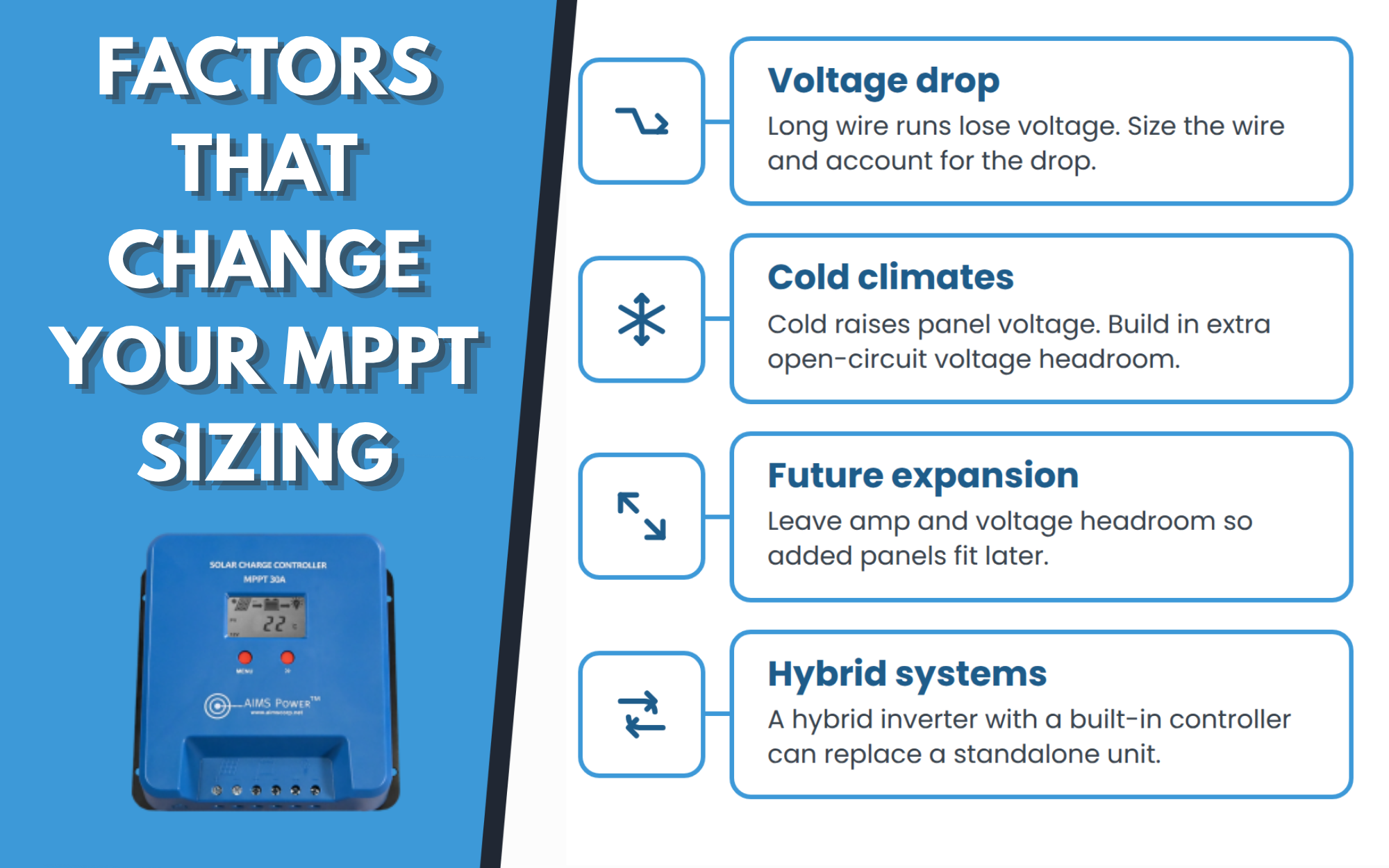
A few conditions shift the math beyond the basic voltage and amp check.
- Voltage drop: Long wire runs between the array and the controller cause voltage drop. Size the wire and account for the drop, so the controller sees the voltage you expect.
- Cold climates: Cold raises panel voltage, so the open circuit voltage margin matters more in cold regions. Build in extra headroom.
- Future expansion: If the array may grow, spec a controller with room above the current amp and voltage load so a later panel addition does not force a controller swap.
- Hybrid systems: In builds that pair solar with battery backup and grid or generator input, a hybrid inverter with an integrated controller can replace a standalone unit, which is worth weighing at the design stage.
Where MPPT Controllers Fit in a System
An MPPT charge controller earns its cost anywhere the array is large enough or the voltage spread wide enough that lost energy adds up.
Off-Grid and Remote Systems
In off-grid and remote systems, every watt harvested counts because there is no grid to fall back on. MPPT tracking pulls the most from the array across changing light, which shortens charge time and keeps the battery bank healthier.
Larger Solar Arrays
On larger solar arrays, high-voltage panel strings paired with a lower-voltage battery bank are exactly the case where MPPT conversion recovers the most energy. This is the setup where PWM would waste the most.
Cold-Climate Installs
Where panels run cold and panel voltage climbs, MPPT both captures the extra voltage as current and, sized correctly, stays within its input range. The open circuit voltage headroom is the design point to watch.
Portable and Mobile Solar
Even with portable solar panels and smaller mobile builds, an MPPT controller squeezes more from a limited array, which matters when panel space is capped by the vehicle or the setup.
Choosing an MPPT Charge Controller With AIMS Power
AIMS Power is a U.S.-based manufacturer with more than 25 years building solar and power conversion equipment, backed by in-house technical support. Beyond charge controllers, AIMS builds the solar panels, inverters, and batteries that make up a complete system, so the parts are designed to work together.
For installers, OEMs, and system designers speccing solar, that means one source for the equipment and the application help to match it to the build. If you are designing a system or sourcing at volume, contact AIMS Power to find the right fit for your project, or to talk through OEM and reseller options.