Best Inverter for Utility and Service Trucks

Best Inverter for Utility and Service Trucks
The Short Answer: The best work truck inverter is a pure sine wave model sized to the tools and electronics the crew actually runs, wired to an auxiliary battery so it pulls power from the secondary power, not the starting battery. Pure sine power allows laptops, diagnostic gear, and other sensitive electronics to run smoothly, while the right wattage rating covers power tools and their startup surge. For most utility and service trucks, an AIMS Power pure sine inverter matched to the load, with overload protection built in, keeps a crew working without idling the engine.

A utility or service truck is a worksite on wheels, and the equipment on board only works if there is power to run it. A work truck inverter turns the truck battery’s DC into the AC power that tools, chargers, and electronics need, so a crew can run a drill, charge a laptop computer, or keep diagnostic equipment live without hunting for an outlet. 

The right inverter depends on what the crew runs, how much power it draws, and how the unit is wired into the truck’s electrical system. Size it too small and it shuts down under load. Wire it poorly and it drains the battery that starts the truck. 

What a Work Truck Inverter Has to Do 

An inverter in a service truck does one core job, turning the vehicle battery’s direct current into usable AC power, but how well it does that job decides what the crew can run. The output has to be clean enough for sensitive electronics, rated for the total wattage on board, and wired so it does not leave the truck unable to start.

Clean Power for Sensitive Electronics 

Modern service work runs on electronics, so the quality of the inverter’s output matters as much as its size. A pure sine wave output matches the power from a wall outlet, which keeps laptops, tablets, diagnostic tools, and other electronic devices running cool and reading accurately.

A rougher waveform can make electronics buzz, run hot, or misread the signal and fault. For a truck that carries any sensitive electronics, a pure sine wave inverter is the safer starting point, since it runs the full range of equipment a crew is likely to plug in.

Power Without Idling the Engine

Running equipment off the battery also means the truck engine does not have to idle to make power. Cutting idle time is something the EPA encourages through idling reduction technologies for trucks, since a stationary engine burns fuel and adds wear with no work to show for it. An inverter paired with an auxiliary battery lets a crew keep tools, lights, and climate control running with the engine off, which saves fuel and keeps the cab quiet on a job site. Most setups like this also use a battery isolator, which lets the alternator charge the auxiliary battery while the truck runs and separates the two batteries once the engine is off, so running loads overnight cannot pull down the battery that starts the truck.

Key things a word truck inverter should deliver: 

  • Clean power: A pure sine wave output that matches grid quality for laptops, chargers, and other electronic devices.
  • Enough wattage: A continuous rating above the total load, with headroom for the surge power tools pull at startup.
  • Overload protection: Built-in shutdown that protects both the inverter and the connected device if the load runs too high.
  • Convenient outlets: AC receptacles and often a USB port for phones and small electronics, which has become a standard feature on many units.

Sizing the Inverter to the Load 

The most common sizing mistake is guessing usage instead of calculating it. A watt inverter that is too small shuts down under load, and one far larger than needed wastes money and battery capacity. The fix is to add up what runs at once and leave room for startup surge.

Running Watts and Surge Watts 

Every load has two numbers that matter. Running watts are what a device draws once it is going, and surge watts are the brief spike it pulls at startup. Power tools, pumps, and anything with a motor can spike well above their running figure for a second or two when they kick on. 

An inverter has a continuous rating and a higher peak rating, and the continuous rating is the one that has to clear the combined running load with headroom to spare. Sizing to running watts alone is what leaves a crew with an inverter that trips the moment a saw starts.

Add Up Total Wattage 

List every electrical device the crew runs at the same time and add up the wattage. A laptop computer and a phone charger draw very little, while power tools, a compressor, or small appliances draw much more and spike higher at startup. 

Size the inverter above that total wattage so it has room for the surge. As a rough guide:

Load on a service truck

Typical draw

Laptop, tablet, phone charging

50 to 150 watts

Diagnostic and test equipment

100 to 300 watts

Corded power tools (drill, grinder)

600 to 1,500 watts

Work lights, small appliances

100 to 500 watts

Inverter microwave or heater

900 to 1,800 watts

A 2000 watt inverter covers most light service work, while crews running larger tools often step up to a higher w inverter rating. When in doubt, size up, since an inverter running well under its rating stays cooler and lasts longer.

AIMS POWER | WORK TRUCK PICK

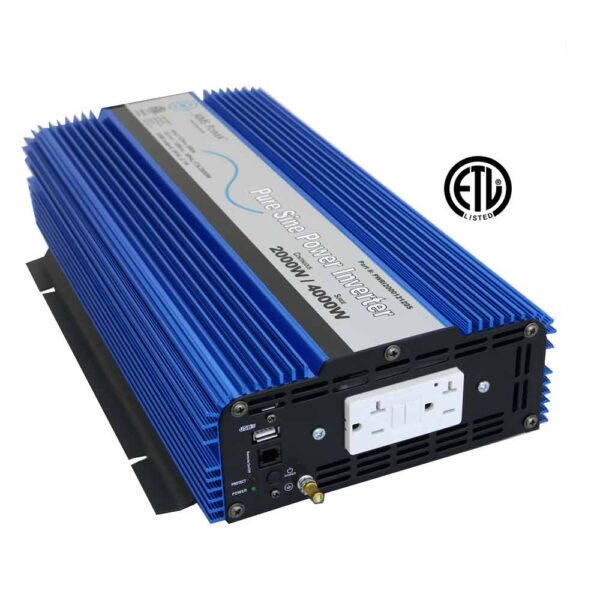
2000W Pure Sine Wave Inverter

2000W Continuous 4000W Surge 12V Input Pure Sine Wave

Power your service truck's laptops, diagnostic tools, chargers, and compatible corded tools with clean AC electricity. Features a GFCI outlet, USB port, and ETL listing to UL 458.

Shop This Inverter →

Protect the Truck’s Battery 

Running an inverter straight off the starter battery can leave a truck that will not start, so most work truck setups add an auxiliary battery or a small auxiliary battery bank dedicated to the inverter. 

A deep cycle battery is built for the repeated draw an inverter puts on it, unlike a starting battery made for short, high bursts to crank the truck engine. Keeping the inverter on its own battery system, charged while the truck runs, protects the vehicle battery that actually starts the truck. 

For heavier use, a larger battery bank extends how long the crew can work before the engine has to run again. 

AIMS POWER | PROTECT THE STARTING BATTERY

Dual Sensing Smart Battery Isolator

300 Amp 12V System Dual Sensing Optional Manual Switch

Lets the alternator charge the auxiliary battery while the truck runs, then separates the two batteries once the engine is off, so overnight loads cannot pull down the battery that starts the truck. Built for vehicles, RVs, and mobile businesses.

Shop This Isolator →

Matching an AIMS Inverter to the Truck 

The right AIMS model comes down to the total wattage on board and how the truck is used.

Pure Sine Wave Sized to the Load

A pure sine wave inverter is the right call for any truck running laptops, diagnostic gear, or other sensitive electronics, since it matches wall-outlet power and keeps electronics from buzzing or faulting. Size it to the load:

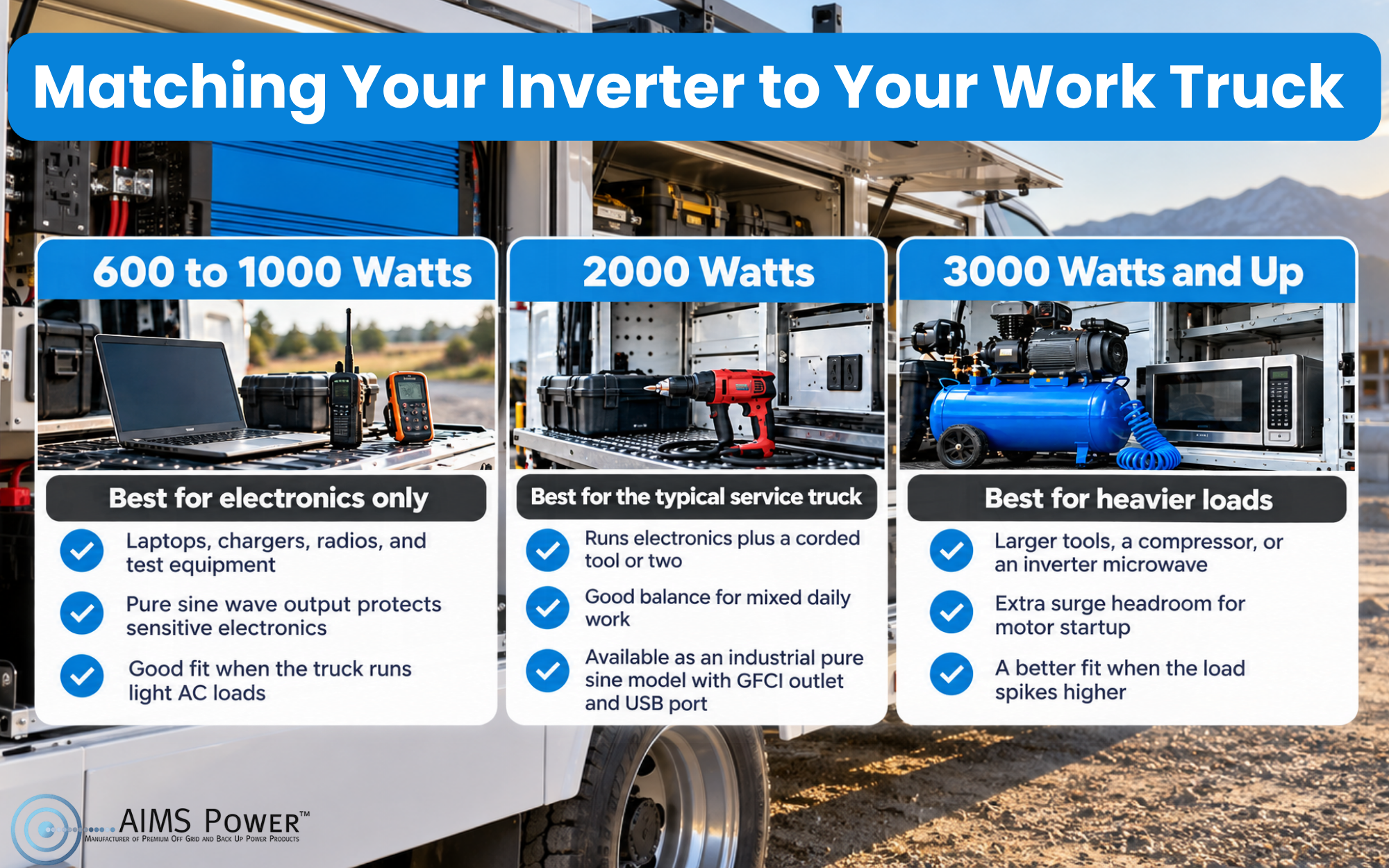
  • 600 to 1000 watts for electronics only, like laptops, chargers, radios, and test equipment.
  • 2000 watts for the typical service truck running electronics plus a corded tool or two, available as an industrial-grade pure sine model with a GFCI outlet and USB port.
  • 3000 watts and up for larger tools, a compressor, or an inverter microwave that need extra surge headroom.

All three sit in the 12 volt pure sine inverter range, which fits the 12 volt system most work trucks run.

Inverter Charger for Overnight Staging

Trucks that park at a yard or plug in overnight benefit from an inverter charger in the 2000 to 3000 watt range. It runs loads from the battery and recharges that battery when shore power or the alternator is available, and the built-in transfer switch moves between sources automatically so the battery system stays ready for the next shift.

Modified Sine for Basic Loads

A crew that only runs simple resistive loads and basic corded tools can use a modified sine inverter as a lower-cost option, best matched to a known, simple set of loads since the stepped waveform is not suited to sensitive electronics. Larger rigs like some semi truck and tractor trailer builds run 24 volt systems, so confirm the truck’s voltage before choosing a model.

Power Needs by Trade 
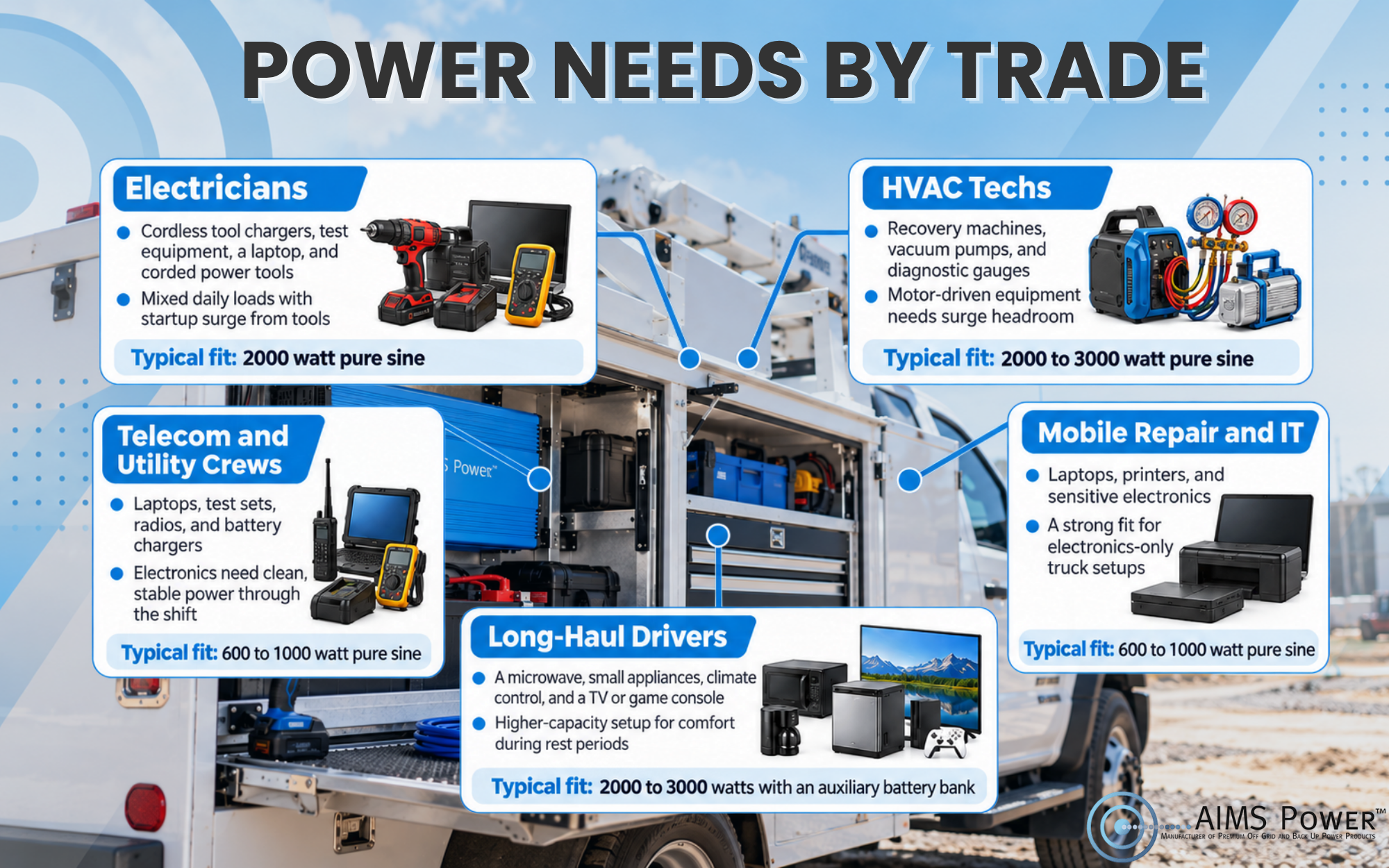
What a crew runs shapes the inverter it needs, and the load looks different across trades. Common examples on a service truck:

  • Electricians: Cordless tool chargers, test equipment, a laptop, and corded power tools that spike at startup.
  • HVAC techs: Recovery machines, vacuum pumps, and diagnostic gauges, several of which are motor-driven and surge on start.
  • Telecom and utility crews: Laptops, test sets, radios, and battery chargers that have to stay live through a shift.
  • Mobile repair and IT: Laptops, printers, and sensitive electronics that need clean pure sine power.
  • Long-haul truck drivers: A microwave, small appliances, climate control, and a video game console or TV during a rest period.

Installation and Power Management 

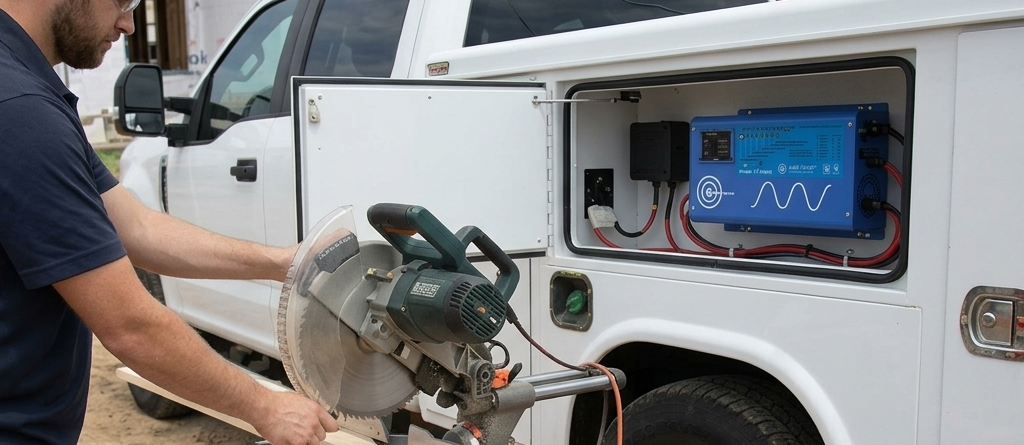
Where and how the inverter is mounted affects both safety and convenience, so many crews mount the unit under a seat or in a center console within reach, with the AC outlets accessible to the cab or the bed, short correctly sized battery cables to keep voltage drop low, and a fuse or breaker close to the battery to protect the wiring. 

The inverter’s overload protection handles the load side, shutting down if the crew plugs in more than the unit can carry. Running the inverter off an auxiliary battery, charged by the alternator or a battery charger while the truck runs, keeps the starting battery untouched, and for a tractor trailer or semi truck with a large auxiliary battery bank that setup can run a microwave, climate control, and electronics through a rest period without idling. 

A dual sensing isolator handles the charging side of that setup, deciding how the auxiliary battery charges and when the starting battery is held back. Planning the install around the actual daily load, rather than the biggest number on the box, is what gives a system that holds up over years of use.

Outfitting Your Fleet with AIMS Power 

AIMS Power has spent more than 25 years, since 2001, building power inverters and battery systems for mobile and commercial use. If you are outfitting a single service truck or a full fleet, contact AIMS Power to match the right inverter to your trucks or to talk through OEM and upfitter options.

Frequently Asked Questions

What size inverter do I need for a work truck? +

The inverter size for a work truck depends on the total wattage of everything the crew runs at once, plus headroom for the surge power tools pull at startup. Add up the loads, then choose a watt inverter rated above that total. A 2000 watt pure sine inverter covers most light service work, while crews running larger tools step up from there.

Do I need a pure sine wave inverter for a service truck? +

A pure sine wave inverter is the right choice for a service truck that runs laptops, diagnostic equipment, or other sensitive electronics. Pure sine power matches a wall outlet, so electronic devices run without the buzzing, heat, or faults a rougher waveform can cause. For basic corded tools only, a modified sine inverter can work, but pure sine covers the mixed loads most trucks carry.

Will an inverter drain my truck battery? +

An inverter can drain a truck battery if it runs straight off the starting battery with the engine off. Most work truck setups add a deep cycle battery bank for the inverter, charged while the truck runs, so the starter battery stays ready to crank the truck engine. Keeping the inverter on its own battery protects the vehicle battery.

Can I run power tools off a truck inverter? +

Running power tools off a truck inverter works as long as the inverter is sized for the tool’s startup surge, not just its running watts. Corded drills, grinders, and similar tools can spike well above their rated draw for a moment at startup, so the inverter needs headroom above the total wattage. A pure sine model also runs tools with electronic controls more smoothly.

Does a work truck inverter have USB ports? +

Many work truck inverters include a USB port along with the AC outlets, which has become a standard feature on a lot of models. The USB port handles phones and small electronics directly, while the AC receptacles run laptops, chargers, and power tools. Check the spec for the number of outlets and USB ports the crew needs.

Select the fields to be shown. Others will be hidden. Drag and drop to rearrange the order.
  • Image
  • SKU
  • Price
  • Description
  • Number of Batteries
  • Battery Type
  • Total Battery Amp Hours
  • Total Battery Capacity kWh
  • Charge Controller Size
  • Charges Battery Types:
  • Inverter Part Number
  • Inverter DC Input Voltage
  • Inverter Output Continuous Watts | Surge
  • Inverter Output Continuous Amps | Surge Amps
  • Inverter Output Type
  • AC Output Voltage
  • AC Charger Amps
  • Hardwire Terminal Block
  • Transfer Switch
  • Number of Outlets
  • Number of Solar Panels
  • Total Solar Watts
  • Panel Type
  • Solar Array Sq Ft
  • Powers Common Devices
  • System Expansion Option
  • Third Party Certification
  • Warranty
  • Battery Wake Up
  • Bluetooth
  • Built-in Heater
  • Inverter AC Input Voltage
  • Remote Option
  • Dimensions - Product
  • Weight - Product
  • Add to cart
Click outside to hide the comparison bar
Compare